JavaScript重点之原型与原型链
JavaScript 之 原型链
对象
理解原型链 的前提是要搞清楚 对象 ,JavaScript中 万物皆对象 ,但是 对象也是有区别的 , 它分为 普通对象 和 函数对象。
Object 、Function 是 JavaScript 中自带的函数对象。
// 在 浏览器 中打印 Object 以及 Function 这两个对象
console.log(typeof Object); //function
console.log(typeof Function); //function


// 普通对象
var o1 = {};
var o2 =new Object();
var o3 = new f1();

console.log(typeof o1); //object
console.log(typeof o2); //object
console.log(typeof o3); //object


// 函数对象
function f1(){};
var f2 = function(){};
var f3 = new Function('str','console.log(str)');


console.log(typeof f1); //function
console.log(typeof f2); //function
console.log(typeof f3); //function
这个例子 可以看出 ,凡是通过 new Function 创建的对象都是函数对象 , 其他的都是普通对象。
注意: f1 , f2 归根结底 都是通过new Function 创建出来的 , Function 以及 Object也都是通过new Function 创建的;JavaScript 中 其他内置对象也都是 通过new Function 创建出来的。
分清楚普通对象 以及 函数对象 这两点 很重要!!!
构造函数
记住普通对象和函数对象的区别之后,我们再来看看 构造函数。
先来看个实例:
// 我们声明了一个 Person 类 , 它具有名字 年龄 以及一个行为 sayName 方法
function Person(name, age) {
 this.name = name;
 this.age = age;
 this.sayName = function() {
   alert(this.name)
 }
}

// 实例化
let xiaoming = new Person("小明",18)
let xiaohong = new Person("小红",18)
例子中xiaoming 以及 xiaohong 都是Person类的实例,这两个实例都会有一个 constructor(构造函数) 属性,这个属性指向的就是Person这个类,它其实就是一个指针,我们来证明下他们之间的关系:
xiaoming.constructor === Person // true
xiaohong.constructor === person // true
在这里我们需要记住两个点:
- 构造函数
- 实例
总结一句话其实就是: 实例的构造函数属性指向构造函数。
原型对象
记住了构造函数和对象的知识点后,我们再来看看原型对象。
在JavaScript中 ,每声明一个对象(函数也是对象)的时候,对象中都会包含一些预定义的属性。其中 函数对象都会有一个prototype 属性 ,而这个 prototype属性指向函数的原型对象
看下实例:
function Person() {}

Person.prototype.name = 'xing'; // 在原型对象上添加了 name 属性
Person.prototype.age  = 28; // 在原型对象上添加了 age 属性

Person.prototype.sayName = function() {  // 在原型对象上添加了 sayName 方法
  alert(this.name);
}

var person1 = new Person();  // 实例化
person1.sayName(); // 'xing'

var person2 = new Person(); // 实例化
person2.sayName(); // 'xing'

console.log(person1.sayName == person2.sayName); //true
我们在Person的prototype属性上添加了各种属性 , 最后在调用的时候它们其实都是同一个 , 这是因为 prototype属性指向的是函数的原型对象,如果你还不理解 ,那 直接不要想那么多 ,它 就是一个普通对象;你只需要记住: prototype 指 函数的原型对象,就如上述例子: Person.prototype 就是原型对象
哦!对了,你还需要记住一个知识点:
在默认情况下,所有的原型对象都会自动获得一个
constructor(构造函数)属性,这个属性(是一个指针)指向prototype属性所在的函数(Person)
好像听不太懂的样子. - -!!!
没关系 ,翻译一下就是: Person.prototype 有一个 constructor 默认属性(自动获得), 这个属性(constructor)指向了 Person , 也就是: Person.prototype.constructor == Person
到了这里 有没有突然反应过来什么?
在上面 讲构造函数的时候 , 是不是讲过 实例的构造函数属性指向构造函数 , 也就是 xiaoming.constructor === Person;好像这样的话 它们之间是不是就会有点联系了啊???
是的!!!
控制台打印看看:
function Person(name,age){
    this.name = name
    this.age = age
    this.sayName = function(){
        console.log(this.name)
    }
}

let xiaoming = new Person("小红", 18)
let xiaohong = new Person("小明", 18)

xiaohong.constructor == Person
// true
xiaoming.constructor == Person
// true
Person.prototype.constructor == xiaohong.constructor
// true
Person.prototype.constructor == xiaoming.constructor
// true
但是为什么xiaoming 跟 xiaohong 会有 constructor 属性呢? 因为 他们是Person 的实例啊!!!
那Person.prototype 为什么也会有constructor属性呢? 因为他也是Person的实例啊!!!
其实就是 Person 在创建的时候 ,创建了一个它的实例并赋值给了它的prototype属性。
结论:原型对象(Person.prototype)是 构造函数(Person)的一个实例。
原型对象其实就是普通对象,但 Function.prototype 除外,它是函数对象,但它很特殊,他没有prototype属性。
看下实例:
function Person(){};
console.log(Person.prototype) //Person{}
console.log(typeof Person.prototype) //Object
console.log(typeof Function.prototype) // Function,这个特殊
console.log(typeof Object.prototype) // Object
console.log(typeof Function.prototype.prototype) //undefined
Function.prototype 为什么是函数对象呢?
上面提到过 凡是通过 new Function 创建的对象都是函数对象 , 其他的都是普通对象。
function Function(){};
var temp = new Function();
Function.prototype = temp; //由new Function()产生的对象都是函数对象
那原型对象是用来做什么的呢?
主要作用是用于继承。
var Person = function(name){
	this.name = name; // tip: 当函数执行时这个 this 指的是谁?
};
Person.prototype.getName = function(){
	return this.name;  // tip: 当函数执行时这个 this 指的是谁?
}
var person1 = new Person('xing');
person1.getName(); //xing
从这个例子可以看出,通过给 Person.prototype 设置了一个函数对象的属性,那有 Person 的实例(person1)出来的普通对象就继承了这个属性,而这个 this 两次都是指向了 person1
__proto__
JavaScript 在创建对象(不论是普通对象还是函数对象)的时候,都有一个叫做__proto__ 的内置属性,用于指向创建它的构造函数的原型对象。
记住:
最普通的对象: 有__proto__属性(指向其原型链),没有prototype属性。
原型对象: 有__proto__属性 , 还有constructor属性(指向构造函数对象))
函数对象: 拥有__proto__、prototype属性(指向原型对象 , 凡是通过new Function()创建的都是函数对象)。
对象 person1 有一个 __proto__属性,创建它的构造函数是 Person,构造函数的原型对象是 Person.prototype ,所以: person1.__proto__ == Person.prototype
贴一张《JavaScript 高级程序设计》的图:
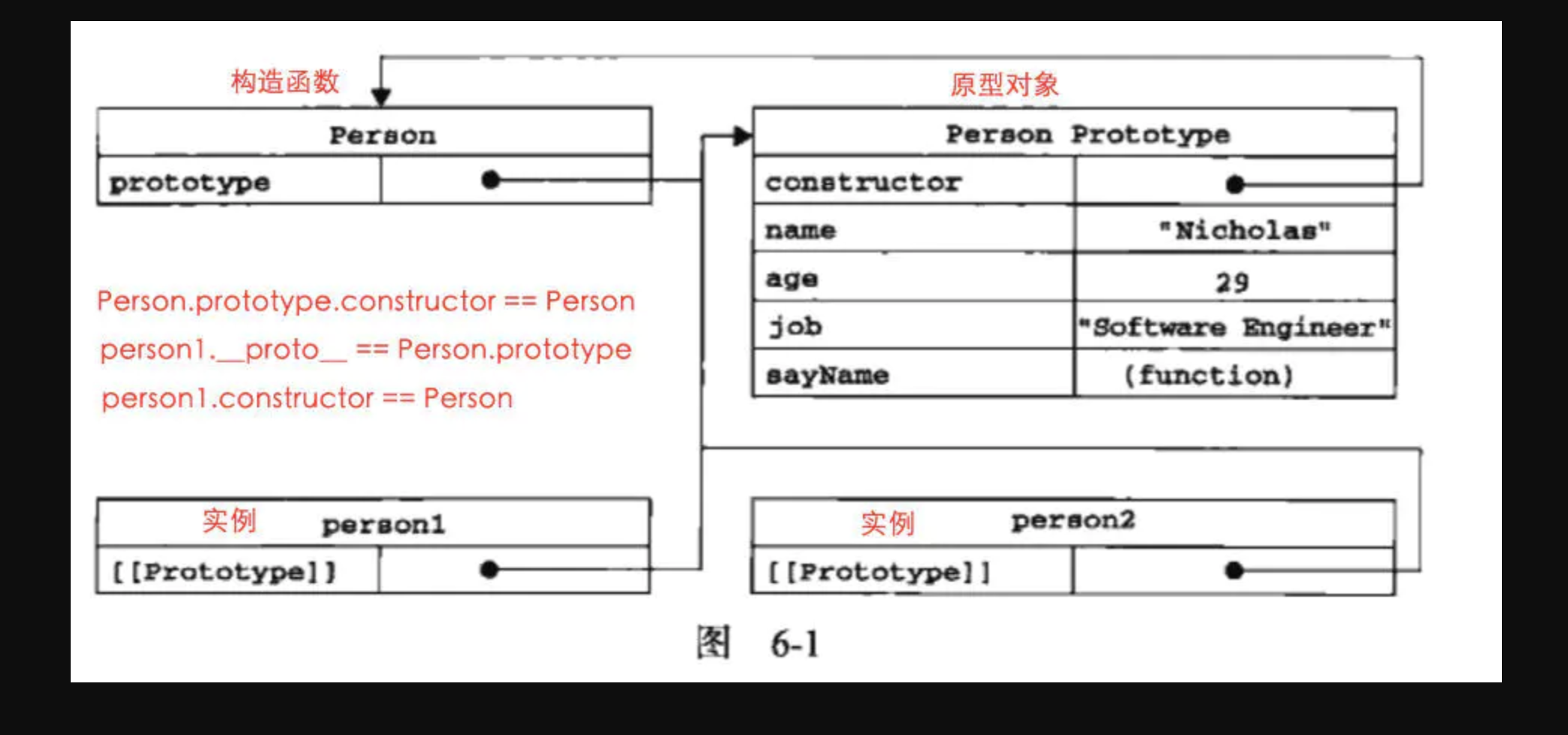
根据上面这个连接图,我们能得到:
Person.prototype.constructor == Person;
person1.__proto__ == Person.prototype;
person1.constructor == Person;
不过要明确一点重要信息就是,这个链接存在于实例与构造函数的原型对象之间,而不是存在于实例与构造函数之间。
构造器
熟悉 JavaScript的同学都知道,创建一个对象我们可以使用字面量的方式来创建一个对象,例如:
let obj = {}它等同于:
let obj = new Object()那么 obj 就是 Object的一个实例 ,所以:
obj.constructor === Object

obj.__proto__ === Object.prototype
同理,可以创建对象的构造器不仅仅有 Object,也可以是 Array,Date,Function等。
所以我们也可以构造函数来创建 Array、 Date、Function
var b = new Array();
b.constructor === Array;
b.__proto__ === Array.prototype;

var c = new Date();
c.constructor === Date;
c.__proto__ === Date.prototype;

var d = new Function();
d.constructor === Function;
d.__proto__ === Function.prototype;
这些构造器都是函数对象:

原型链
- 什么是原型链呢?
原型链的核心就是依赖对象的_proto_的指向,当自身不存在的属性时,就一层层的扒出创建对象的构造函数,直至到Object时,就没有_proto_指向了。
- 分析原型链(属性查找)
因为_proto_实质找的是prototype,所以我们只要找这个链条上的构造函数的prototype。其中Object.prototype是没有_proto_属性的,它==null。
练习题:
function Person(name){
  this.name = name
}

let person1 = new Person("xing")

题目一: person1.__proto__ 是什么?
题目二: Person.__proto__ 是什么?
题目三: Person.prototype.__proto__ 是什么?
题目四: Object.__proto__ 是什么?
题目五: Object.prototype.__proto__ 是什么?
题目一:
person1.__proto__ === Person.prototype // 实例的__proto__ 指向 实例的构造函数的prototype ,结果为true题目二:
Person.__proto__ === Function.prototype // Person 的 __proto__ 指向 创建它的构造函数的prototype ,结果为true题目三:
Person.prototype.__proto__ === Object.prototype // 记住: 原型对象其实就是普通对象,那么它的构造函数肯定就是 Object.prototype题目四:
Object.__proto__ === Function.prototype // 跟题目二是一样的, Object 其实也是构造函数题目五:
Object.prototype.__proto__ === null // Object.prototype 对象也有proto属性,但它比较特殊,为 null 。因为 null 处于原型链的顶端,这个只能记住。
函数对象
所有函数对象的proto都指向Function.prototype,它是一个空函数(Empty function)
Number.__proto__ === Function.prototype  // true
Number.constructor == Function //true

Boolean.__proto__ === Function.prototype // true
Boolean.constructor == Function //true

String.__proto__ === Function.prototype  // true
String.constructor == Function //true

// 所有的构造器都来自于Function.prototype,甚至包括根构造器Object及Function自身
Object.__proto__ === Function.prototype  // true
Object.constructor == Function // true

// 所有的构造器都来自于Function.prototype,甚至包括根构造器Object及Function自身
Function.__proto__ === Function.prototype // true
Function.constructor == Function //true

Array.__proto__ === Function.prototype   // true
Array.constructor == Function //true

RegExp.__proto__ === Function.prototype  // true
RegExp.constructor == Function //true

Error.__proto__ === Function.prototype   // true
Error.constructor == Function //true

Date.__proto__ === Function.prototype    // true
Date.constructor == Function //trueJavaScript中有内置(build-in)构造器/对象共计12个(ES5中新加了JSON),这里列举了可访问的8个构造器。剩下如Global不能直接访问,Arguments仅在函数调用时由JS引擎创建,Math,JSON是以对象形式存在的,无需new。它们的proto是Object.prototype。如下:
Math.__proto__ === Object.prototype  // true
Math.construrctor == Object // true

JSON.__proto__ === Object.prototype  // true
JSON.construrctor == Object //true上面说的函数对象当然包括自定义的。如下:
// 函数声明
function Person() {}
// 函数表达式
var Perosn = function() {}
console.log(Person.__proto__ === Function.prototype) // true
所有的构造器都来自于
Function.prototype,甚至包括根构造器Object及Function自身。所有构造器都继承了Function.prototype 的属性及方法。如length、call、apply、bind
除了 Function.prototype 既是对象又是函数对象之外,其它的构造器的prototype都是一个对象:
console.log(typeof Function.prototype) // function
console.log(typeof Object.prototype)   // object
console.log(typeof Number.prototype)   // object
console.log(typeof Boolean.prototype)  // object
console.log(typeof String.prototype)   // object
console.log(typeof Array.prototype)    // object
console.log(typeof RegExp.prototype)   // object
console.log(typeof Error.prototype)    // object
console.log(typeof Date.prototype)     // object
console.log(typeof Object.prototype)   // object
上面提到 Function.prototype 是一个空的函数 , 你可以试着打印看看这个空函数:
console.log(Function.prototype)
知道了所有构造器(含内置及自定义)的__proto__都是Function.prototype,那Function.prototype的__proto__是谁呢?
相信都听说过JavaScript中函数也是一等公民,那从哪能体现呢?如下:
console.log(Function.prototype.__proto__ === Object.prototype) // true
这说明所有的构造器也都是一个普通 JS 对象,可以给构造器添加/删除属性等。同时它也继承了Object.prototype上的所有方法:toString、valueOf、hasOwnProperty等。
最后Object.prototype的proto是谁?Object.prototype.__proto__ === null // true
Object.prototype的原型是null,null指空对象。世界上最难的事情是从0生出1,无中生出有,Object.prototype就是照着null的样子创造了1。
prototype
在 ECMAScript 核心所定义的全部属性中,最耐人寻味的就要数
prototype属性了。对于 ECMAScript 中的引用类型而言,prototype是保存着它们所有实例方法的真正所在。换句话所说,诸如toString()和valuseOf()等方法实际上都保存在prototype名下,只不过是通过各自对象的实例访问罢了— 《JavaScript 高级程序设计》第三版 P116
我们知道 JS 内置了一些方法供我们使用,比如:
对象可以用 constructor/toString()/valueOf() 等方法;
数组可以用 map()/filter()/reducer() 等方法;
数字可以用 parseInt()/parseFloat()等方法;
当我们创建一个对象时:
let Person = new Object()


// Person 是 Object 的实例,所以 Person 继承了Object 的原型对象Object.prototype上所有的方法:

console.dir(Object.prototype) // Object.prototype 其实就是一个普通对象
/**
  Object
  constructor: ƒ Object()
  __defineGetter__: ƒ __defineGetter__()
  __defineSetter__: ƒ __defineSetter__()
  hasOwnProperty: ƒ hasOwnProperty()
  __lookupGetter__: ƒ __lookupGetter__()
  __lookupSetter__: ƒ __lookupSetter__()
  isPrototypeOf: ƒ isPrototypeOf()
  propertyIsEnumerable: ƒ propertyIsEnumerable()
  toString: ƒ toString()
  valueOf: ƒ valueOf()
  toLocaleString: ƒ toLocaleString()
  get __proto__: ƒ __proto__()
  set __proto__: ƒ __proto__()
*/
Object 的每个实例都具有以上的属性和方法。
所以我可以用 Person.constructor 也可以用 Person.hasOwnProperty。
当我们创建一个数组时:
let num = new Array()
// num 是 Array 的实例,所以 num 继承了Array 的原型对象Array.prototype上所有的方法:

console.log(Array.prototype)
/**
	[constructor: ƒ, concat: ƒ, copyWithin: ƒ, fill: ƒ, find: ƒ, …]
  length: 0
  constructor: ƒ Array()
  concat: ƒ concat()
  copyWithin: ƒ copyWithin()
  fill: ƒ fill()
  find: ƒ find()
  findIndex: ƒ findIndex()
  lastIndexOf: ƒ lastIndexOf()
  pop: ƒ pop()
  push: ƒ push()
  reverse: ƒ reverse()
  shift: ƒ shift()
  unshift: ƒ unshift()
  slice: ƒ slice()
  sort: ƒ sort()
  splice: ƒ splice()
  includes: ƒ includes()
  indexOf: ƒ indexOf()
  join: ƒ join()
  keys: ƒ keys()
  entries: ƒ entries()
  values: ƒ values()
  forEach: ƒ forEach()
  filter: ƒ filter()
  flat: ƒ flat()
  flatMap: ƒ flatMap()
  map: ƒ map()
  every: ƒ every()
  some: ƒ some()
  reduce: ƒ reduce()
  reduceRight: ƒ reduceRight()
  toLocaleString: ƒ toLocaleString()
  toString: ƒ toString()
  Symbol(Symbol.iterator): ƒ values()
  Symbol(Symbol.unscopables): {copyWithin: true, entries: true, fill: true, find: true, findIndex: true, …}
  __proto__: Object

*/
这样你就明白了随便声明一个数组,它为啥能用那么多方法了。
并且它的原型链(__proto__)中还有对象的方法。
当我们创建一个函数时:
var f = new Function("xing","return xing;"); //当然你也可以这么创建 f = function(x){ return x }
console.log(f.arguments) // arguments 方法从哪里来的?
console.log(f.call(window)) // call 方法从哪里来的?
console.log(Function.prototype) // function() {} (一个空的函数)
console.dir(Function.prototype);
疑问来了,我们之前说过:
所有函数对象proto都指向
Function.prototype,它是一个空函数(Empty function)
嗯! 我们确实证明了它就是一个空函数,但是你也别忘了我们之前说过的:
所有对象的 __proto__ 都指向其构造器的 prototype我们下面再复习下这句话。
// 先看看 JS 内置构造器:

var obj = {name: 'xing'}
var arr = [1,2,3]
var reg = /hello/g
var date = new Date
var err = new Error('err')

console.log(obj.__proto__ === Object.prototype) // true
console.log(arr.__proto__ === Array.prototype)  // true
console.log(reg.__proto__ === RegExp.prototype) // true
console.log(date.__proto__ === Date.prototype)  // true
console.log(err.__proto__ === Error.prototype)  // true
再看看自定义的构造器,这里定义了一个 Person:
function Person(name) {
  this.name = name;
}
var p = new Person('xing')
console.log(p.__proto__ === Person.prototype) // true
p 是 Person 的实例对象,p 的内部原型总是指向其构造器 Person 的原型对象 prototype。
每个对象都有一个 constructor 属性,可以获取它的构造器,因此以下打印结果也是恒等的:
function Person(name) {
    this.name = name
}
var p = new Person('xing')
console.log(p.__proto__ === p.constructor.prototype) // true上面的Person没有给其原型添加属性或方法,这里给其原型添加一个getName方法:
function Person(name) {
    this.name = name
}
// 修改原型
Person.prototype.getName = function() {}
var p = new Person('xing')
console.log(p.__proto__ === Person.prototype) // true
console.log(p.__proto__ === p.constructor.prototype) // true可以看到p.__proto__与Person.prototype,p.constructor.prototype都是恒等的,即都指向同一个对象。
注意:如果换一种方式设置原型,结果就有些不同了。
>function Person(name) {
   this.name = name
>}
>// 重写原型
>Person.prototype = {
   getName: function() {}
>}
>var p = new Person('xing')
>console.log(p.__proto__ === Person.prototype) // true
>console.log(p.__proto__ === p.constructor.prototype) // false
这里直接重写了 Person.prototype(注意:上一个示例是修改原型)。输出结果可以看出p.__proto__仍然指向的是Person.prototype,而不是p.constructor.prototype。
这也很好理解,给Person.prototype赋值的是一个对象直接量{getName: function(){}},使用对象直接量方式定义的对象其构造器(constructor)指向的是根构造器Object,Object.prototype是一个空对象{},{}自然与{getName: function(){}}不等。如下:
var p = {}
console.log(Object.prototype) // 为一个空的对象{}
console.log(p.constructor === Object) // 对象直接量方式定义的对象其constructor为Object
console.log(p.constructor.prototype === Object.prototype) // 为true
复习原型链
function Person(){}
var person1 = new Person();
console.log(person1.__proto__ === Person.prototype); // true
console.log(Person.prototype.__proto__ === Object.prototype) //true
console.log(Object.prototype.__proto__) //null

Person.__proto__ == Function.prototype; //true
console.log(Function.prototype)// function(){} (空函数)

var num = new Array()
console.log(num.__proto__ == Array.prototype) // true
console.log( Array.prototype.__proto__ == Object.prototype) // true
console.log(Array.prototype)
console.log(Object.prototype.__proto__) //null

console.log(Array.__proto__ == Function.prototype)// true
疑问一:
Object.__proto__ === Function.prototype // true

// Object 是函数对象,是通过new Function()创建的,所以Object.__proto__指向Function.prototype。(所有函数对象的__proto__都指向Function.prototype)
疑问点二:
Function.__proto__ === Function.prototype // true

// Function 也是对象函数,也是通过new Function()创建,所以Function.__proto__指向Function.prototype。
自己是由自己创建的,好像不符合逻辑,但仔细想想,现实世界也有些类似,你是怎么来的,你妈生的,你妈怎么来的,你姥姥生的,……类人猿进化来的,那类人猿从哪来,一直追溯下去……,就是无,(NULL生万物)
正如《道德经》里所说“无,名天地之始”。
疑问点三:
Function.prototype.__proto__ === Object.prototype //true

// Function.prototype是个函数对象,理论上他的__proto__应该指向 Function.prototype,就是他自己,自己指向自己,没有意义。这里 鸡生蛋还是蛋生鸡 ? Object.prototype 可以看作是对象的祖先 , Object 是有 Function (包括它自己)创建出来的,但是 Function 作为一个对象 又可以看作是由Object创建出来的。所以 Object 就当成了祖宗 , 原型链也就有了终点。
总结:
- 原型和原型链是JS实现继承的一种模型。
- 原型链的形成靠的是
__proto__而非prototype,正如我们之前说的那句话,实例和 原型对象 存在一个连接;不过要明确一点重要信息就是,这个链接存在于实例与构造函数的原型对象之间,而不是存在于实例与构造函数之间。
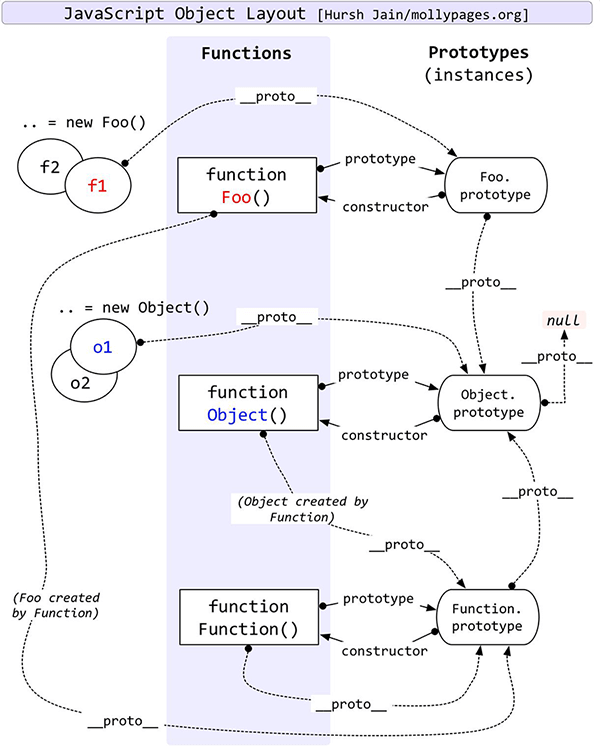
最后献上一张原型链图,相信阅读完后的你看这张图会有一定的清晰度了.
本博客所有文章除特别声明外,均采用 CC BY-SA 4.0 协议 ,转载请注明出处!